I connect OpenAI, Claude, Gemini, or local open-source models to your app, scraper, or database. LLM pipelines, AI content classifiers, local model setup with Ollama — starting at €100. If you have data that needs to be processed, sorted, classified, or enriched with AI, contact me and I'll tell you what it takes.
Quick Answer
- Starting price: €100 for a basic LLM pipeline
- Full scraper + AI + database pipeline: €200–300
- Delivery: 3–7 days depending on complexity
- Supported models: GPT-4o, Claude 3.5, Gemini, Llama, Mistral, Ollama
- Tech stack: Python, REST APIs, PostgreSQL, Docker
What I Build
- LLM pipeline setup — connect OpenAI, Claude, or open-source models to your data
- AI content classifiers — tag, sort, or categorize data automatically with an LLM
- Scraper + LLM + database pipelines — scrape, process with AI, insert clean results
- Local AI model setup — install and run Ollama or LM Studio on your server
- Prompt engineering — design reliable prompts that give consistent structured output
- RAG systems — connect a model to your documents or knowledge base
- Chatbot integration — embed an AI assistant into your site or Telegram bot; see my Telegram bot development guide if you need the bot built too
Real Project: Scraper + LLM + Database Pipeline
A client needed to collect product listings from multiple e-commerce sites, extract structured attributes (category, material, size range, target audience), and insert clean records into a PostgreSQL database for their inventory system. Manual tagging was taking 8 hours per day.
The solution was a three-stage Python pipeline:
- Scraper stage — Python scraper collects raw product data (title, description, images) from target sites on a daily schedule
- LLM processing stage — each product description is sent to GPT-4o-mini with a structured prompt that extracts specific attributes and returns clean JSON
- Database stage — parsed JSON is validated and inserted into PostgreSQL with error logging for any records that fail validation
Result: 8 hours of manual work reduced to zero. 500+ products processed automatically every night. The client reviews the database directly instead of tagging raw data.
Local AI Model on a Private Server
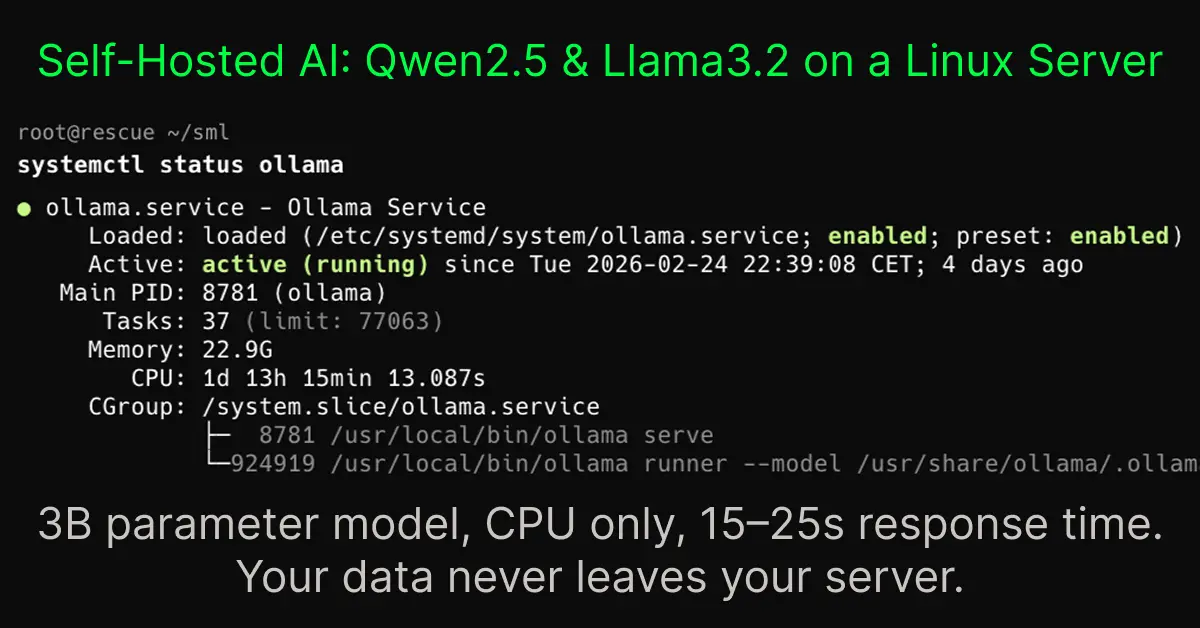
For another project involving sensitive internal documents, the client needed AI processing without sending data to external APIs. I set up Ollama with a Llama 3 model on their Ubuntu VPS, configured GPU acceleration with CUDA, and built a Python wrapper that their team could call via a simple REST endpoint. All processing stayed on their infrastructure. If you need a reliable web server to host this kind of setup, see my Nginx configuration guide.
Cloud AI vs Local Models: Which to Choose
| Factor | Cloud API (OpenAI, Claude) | Local Model (Ollama, LM Studio) |
|---|---|---|
| Cost per request | Pay per token, scales with volume | Free after setup, fixed server cost |
| Data privacy | Data sent to external servers | Stays on your infrastructure |
| Model quality | Best available (GPT-4o, Claude 3.5) | Good, improving rapidly (Llama 3, Mistral) |
| Setup complexity | Simple API key integration | Requires server setup, GPU optional |
| Best for | Most business use cases, best results | High volume, sensitive data, offline needs |
For most projects I recommend starting with a cloud API. It is faster to deploy, gives better results, and the cost is lower than the development time needed to tune a local model. Local models make sense for high-volume processing or when data privacy is a hard requirement.
What You Get
- Full Python source code: Clean, documented code you own completely
- Prompt engineering: Prompts tested for consistent, structured output — not just first-pass attempts
- Error handling and fallbacks: Pipeline recovers from API failures, rate limits, and malformed responses
- Cost estimate: I calculate expected monthly API costs before you commit
- Deployment: Pipeline deployed and running on your server or cloud environment
- 7 days of post-delivery support: Bug fixes and prompt adjustments after delivery at no extra cost
How It Works
- Contact me — describe what data you have, what you want AI to do with it, and what the output should look like.
- I design the pipeline — I confirm the approach, model choice, expected costs, and fixed project price within 24 hours.
- I build and test — pipeline built, prompts tuned, output validated on real data.
- Delivery and deployment — running on your server, you verify output quality, I adjust anything needed.
- Handoff — source code, documentation, and 7 days of support included.
AI & LLM Integration Pricing
Fixed price per project. Agreed before work starts. API usage costs (OpenAI, Anthropic) are separate and paid directly by you to the provider.
| Service | What It Includes | Price | Delivery |
|---|---|---|---|
| LLM Pipeline Setup | Connect OpenAI, Claude, or Gemini to your data or workflow | from €100 | 2–3 days |
| AI Content Classifier | Data in, tagged and sorted by LLM, structured output | from €120 | 3–4 days |
| Local AI Model Setup | Ollama + open-source model on your Linux server, GPU optional | from €150 | 2–4 days |
| Chatbot Integration | AI assistant embedded in your site or Telegram bot | from €150 | 3–5 days |
| Scraper + LLM + Database | Full pipeline: scrape, process with AI, insert clean results to DB | from €200 | 5–7 days |
| RAG System | Connect model to your documents or knowledge base | from €250 | 5–7 days |
API costs: OpenAI, Anthropic, and Google API usage is billed directly to your account. I calculate the expected monthly cost as part of the project scoping so you know before committing.
Frequently Asked Questions
- How much does AI integration cost for a small business?
- A basic LLM pipeline connecting OpenAI or Claude to your existing app or data starts at €100. A full scraper + LLM processing + database pipeline costs €200–300. Price depends on complexity and the number of integrations involved.
- How do I connect OpenAI to my website?
- You connect OpenAI via their REST API using Python. You send your data as a prompt, receive the model's response, and use it in your workflow. I handle the API setup, prompt engineering, response parsing, and wiring into your existing system.
- What is an LLM pipeline?
- An LLM pipeline is a sequence of steps where data is collected, sent to a language model for processing, and the result is used or stored. Example: scrape product descriptions, send them to GPT-4o for category classification, insert classified results into a database automatically.
- Can I run an AI model locally on my server?
- Yes. Ollama lets you run open-source models like Llama 3, Mistral, or Gemma locally without sending data to external APIs. I can install and configure local models on your Linux server, including GPU acceleration with CUDA if your server supports it.
- Which AI model should I use for my project?
- For most business tasks, GPT-4o or Claude 3.5 Sonnet via API give the best results. For cost-sensitive high-volume tasks, GPT-4o-mini or local models via Ollama are better. I recommend the right model after understanding your specific use case and budget.